Tuesday, June 11, 2019

Day 1: Religious Literacy: Sikhism


Wow!  Just wow...what an amazing day of learning!  Today we started our day with an overview of religious literacy by listening to some great speakers: Linda Wertheimer, the author of Faith Ed and Benjamin Marcus, from the Religious Freedom Center.  They were both so knowledgeable and passionate and imparted some great information; however what I'd really like to focus on in today's post is my learning on Sikhism.


Before today, I'm embarrassed to say I had no real knowledge of Sikhism other than that it originated in India and that Sikh men wear turbans and the women wear head coverings.  What I learned today is that Sikhism, the world's fifth largest religion, is quite beautiful.


When we arrived, we were warmly welcomed into their center.  After removing our shoes and covering our heads with hair coverings, we were asked to join them for Langar, a shared meal that they prepared for us.  We sat on the floor as is their custom, as sitting together at the same level equalizes everyone.  They then served us the delicious food that they had prepared for us.  After Langar, we moved toward a meeting area where we had an opportunity to listen to Sikh children share a few of their experiences and then were provided an abundance of information on Sikhism.  The Sikh's believe that there is only one God. The basic tenets of their faith are that God's name is to be remembered in every breath, that they should earn their living honestly, share their good fortunes with those that are less fortunate, and to engage in selfless service.  Additionally, Sikh's believe that all people are equal regardless of their race, gender, religion, or social class. The Sikh's Holy Scripture is known as the Guru Granth Sahib.  The Guru Granth Sahib is at the heart of their worship and contains devotional compositions written by Sikh teachers known as "gurus" and hymns which are mainly written in the Punjabi language.  The Sikh's believe that the purpose of life is to try to integrate their individual personality with God.  The Sikh's religious tenets directly influence their behaviors of serving others and welcoming all as their equals which was evident during Langar and certainly created a sense of belonging.  


After the student panel and the presentation was finished, we were welcomed into their Gurdwara, the Sikh place of worship. There the students played an instrument and sang a hymn.  During an actual service, worshipers may join in singing the hymns, lead prayer, or just meditate and may come and go as they see fit.   
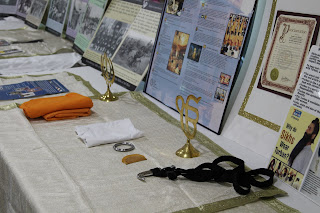


The Sihk's practice the Five K's also known as the Articles of Faith.  The articles of faith include: unshorn hair to represent their spirituality, a comb to represent their cleanliness, a steel bracelet, representing their self restraint and connection God, a short sword, to symbolize an emblem of courage, inner strength, and commitment, and lastly a type of underwear knickers to represent their purity of moral character.   Additionally, I learned that Sikh men wear turbans and Sikh women wear head coverings to protect their uncut hair and to express themselves outwardly to others as a Sikh.  These behaviors create a sense of community with their fellow Sikh's as they illustrate the belief that they are all equal during their worship and their dress.


I am so thankful for the Sikh's who welcomed us into their center and community and shared their beliefs, practices, and customs with us.  Thank you!

Becky

Monday, June 10, 2019

Why do people fear, hate, or discriminate another person that is different than themselves?


Image result for knowledge is power

         Image result for essential question      


My religious literacy course's assignment for today is to develop my essential question for this course...I guess I am trying to figure out, why people fear, hate, or discriminate others because they are different?  This leads to an even bigger question, how do we stop it?  I see fear, hate, and discrimination quite frequently in working with my students with special needs; however I also overhear or note it when making small talk with family, friends, and even random acquaintances when the topic of other cultures and religions comes up.  For whatever reason or as I see it...blessing, I just don't think that way and never have.  When it's in reference to those with special needs, I'm knowledgeable and passionate and have no problem explaining to people why they are wrong, quite passionately.  You have been forewarned...don't ever use the "R" word around me.

                                          Image result for negative comments

When negative comments are made about people of different cultures or religions, I feel strongly this is wrong but I don't always know how to respond or justify why I feel that way.  I often feel confused or upset that people feel so negatively about a person they've never met just because of what they believe, what they are wearing, or how they look.  My hope in taking this course is that I will become more knowledgeable about history, traditions, and religions, the why...so I myself have more knowledge and can in turn help people understand that differences aren't to be feared but rather understood and possibly embraced.           

                                                Image result for knowledge is power                   

Becky                                                                                         


Thursday, June 6, 2019

๐ŸŒžJust some light summer learning...religious literacy ๐ŸŒž


https://drive.google.com/uc?export=view&id=1G6d_61-fre4sWsF-OaMGwV3zSJsYX1qR

I'm seriously excited about taking this course "Religious & Cultural Bus Tour".   I truly love learning and feel pretty lucky to get this experience.

One of my first assignments for the course is to consider why it is important for educators to develop religious literacy.  Being a citizen of of the USA, I feel I'm truly blessed to have the freedom to believe in whatever religion I choose.  I also understand that if I truly believe and intend on making a positive impact toward democracy and peace, I should be knowledgeable about all religions, not just my own.  More than 1/2 of my caseload includes students who have a language other than English spoken in their home.  Additionally, almost 1/2 of my students and their families practice other religions than Christianity including: Hinduism, Judaism, Islam, or are Agnostic.   Religious illiteracy facilitates prejudice, hostility, and conflict which is completely counter to democracy and peace.

https://drive.google.com/uc?export=view&id=1a8SPK47e0R90sdxbqVZJhJ52kW6Oje2t

I was raised Catholic and attended a Catholic grade school.  Our family moved as I was beginning my freshman year or I would have attended a Catholic high school as well.   While I loved the Catholic traditions, as I became older, I began to question some of the church's practices.  When I met my husband who was not a Catholic but rather a Lutheran, it wasn't a big deal to me but it was a big deal to my grandparents.  My grandparents said they wouldn't come to our wedding if I wasn't married in the church.  As I was a practicing Catholic and because it was really important to me that they attend our wedding, we agreed to do so.   We attended "pre-cana" classes and attended the church just about every Sunday.  I can remember distinctly one particular mass watching my soon to be husband: kneel, sit, bow his head, kneel, stand, etc. for me, I can remember thinking "wow, this guy really loves me" and "does he really understand why he is doing all of this?".  While being a Catholic was important to me, it was more important to me that my husband and I have a relationship with God.  After we married, and had some great conversations, we began looking for a church that would work for us and our someday family.   As we were both were Christians, we didn't search for different religions but rather a different way to express our devotion to God.  With that said, the opportunity to observe various Christian churches, their traditions and practices was quite interesting, eye-opening, and at times intimidating.   After attending many different churches, we found "our church" 18 years ago.  My faith and relationship with God continue to be a big part of who I am.

Image result for parkview christian church

As I consider my overall goals for this course, I really want to learn about other religions so that I can continue to grow as a person.  I believe it's important to have a greater understanding and awareness of religions so that I can promote peace and and democracy in this diverse world we live in.  As I've said my faith and relationship with God are a big part of who I am.  I do not believe that my religion is the "best" religion or the only one.  I believe everyone's faith or lack there of is a very personal one.  In order to best understand one another, we should learn from one another.  The history, the practices, the why...I want to better understand others.

Becky


What does summer really look like for a teacher?


https://drive.google.com/uc?export=view&id=1_h1j1h0Nwp4izLa6AN5TMjN43Mp5aTPs

Hi all!  I'm back.... I’m smiling again and the sun is out!  

I took a very long unplanned break because by January of this year, I really didn't have any energy left to give beyond what my own family and my students needed.  Sounds kind of yucky but it's the truth.  For many reasons that I won't bore you with, I found this year to be particularly tough. Summer break being delayed a week by snow days didn't help... damn Chicago weather.  With that said, I've been on summer break for SIX glorious days and already feel a bit better.  I've slept in a few mornings, read one book for fun, and have been spending time with my family.  Exactly what this girl needed! Okay, still needs...
https://drive.google.com/uc?export=view&id=1HzJWxKO02zntYfg71ouOPaNDjA83p5l_
https://drive.google.com/uc?export=view&id=1TPCzocdZ2xCkGuxNSs-LuZjXjLzBdjHX
My hope and plan is that next year my school year will be a bit more manageable and calm.  Fingers crossed!  If that is the case and I pray it is, I will be more active in sharing what's happening on my Autism SLP adventure.   I'm also planning on posting a bit this summer to get back in the swing of things as I have quite a few draft posts that I never published. 

So to get back to the question "what does summer really look like for a teacher?" or at least this SLP/teacher?   Yes, it's true, I do get to sleep in as well as do many of the things I love but don't ordinarily get to do during the school year.  Read books for FUN, travel, sleep in, walk my dog everyday, enjoy my fire pit with family/friends or alone with a great book and a glass of wine.  I also do so many things I don't get to do during the school year, like clean out closets, get to the gym multiple times during the week, cook regularly for my family, and most importantly reconnect with good friends.  I also spend a ton of summer working on things for school such as finishing my medicaid billing, planning, organizing, and learning.  I really don't think many people who aren't teachers or who have teachers in their family understand how much a good teacher does during the summer.  Yes, it is an absolute perk to be off and have a flexible schedule in the summer but it's not just well deserved but absolutely needed.  Teaching is caring for young little people that require every ounce of energy, care, love, and skillset we have.  It is 100% well worth it but it's also exhausting physically, mentally, and emotionally.  Teaching is not a job you put away at 5pm but one that you carry everywhere: every school night until 9 or 10pm and Sunday, your dreams, insomnia "events", the shower, your weekends, and your summer.  Truly!  Our students are our kids in so many ways and we don't turn it off with a switch.  With that said, summer is like a dimmer, we turn it way down to replenish, rejuvenate, reconnect, and relax.

This summer I will be doing all of the above things I mentioned with learning being front and center right now.  I love learning! If I ever become stagnant, it is time to leave the field.  "Our" kids deserve it.  This summer I'll be learning a lot more about many SLP related things such as AAC (Augmentative and Alternative communication), SEL (Social Emotional Learning), behavior, and Religion and Culture. 

I'm really excited that after multiple attempts, I was finally able to enroll in a course titled "Religious and Cultural Bus Tour".  Beginning on Monday, I will be back as a student in the classroom for 6 full days of learning about the various religions and cultures of my students and I can't wait!  For the next week or so, I'll be posting about my learning as part of the course I'm taking.  I really hope you'll follow along on this adventure.

Becky


Sunday, January 20, 2019

Are you supporting students with behavior: where to start? Be the "giver of good things" and gain instructional control.

Let's be real...supporting students with behavior is TOUGH!

                                          Image result for overwhelmed

At times, it can be scary, overwhelming, and quite humbling.  Trust me when I say I have felt this way on multiple occasions.   With that said, it is beyond rewarding to see these same students later use appropriate replacement behaviors that your team has worked tirelessly to teach so that they can develop peer relationships, access academics, and so much more.  

This week we have a student transitioning into our program who is going to require a great deal of support.  We were fortunate to be able to observe him prior to his transition as well as to collaborate with his current team.  So where do we start when we get a new student??   

                                                Image result for where to start

#1  Building positive relationships will be our first and foremost priority.  We do this through pairing ourselves with positive reinforcers and activities.  By pairing yourself with items and/or activities that the child desires you are associating yourself with "good things".  Essentially, your goal is to be seen as "the giver of good things".  Initially, you are the one providing access to the desired items.  The child learns that being with YOU means "good things" happen.  

                                               Image result for oprah things

#2 Once you have paired yourself with the child, the child sees you as trustworthy.   As, the child trusts that you are "the giver of good things", you can now begin to work on gaining instructional control.  This may look very different depending on the child's skills.  It may look like you asking them to follow a simple command or to imitate an action that is in already within their skill set.  Here are some examples:

Johnny loves spinning tops.  You have previously given him access to these tops (i.e. pairing).  Additionally, you know that Johnny understands the command "stand up".  The next time he wants the tops, you ask him to "stand up" and as soon as he does, you provide him with the tops.  "You are standing! Here you go."

Ann loves microphones.  You have previously given her access to the microphone (i.e. pairing).  Additionally, you know that Ann imitates gross motor actions such as clapping.  The next time she wants the microphone, you ask her to "do this" and then you model clapping your hands.  As soon as she claps her hands, you provide her with the microphone "you showed me clapping! Here take the microphone."

This can be trickier when a student doesn't demonstrate understanding of simple commands and is not yet imitating but it can still be done.  It requires you to observe the student and note what he can do.  Can he push the home button on the iPad?  Does he eat a preferred snack such as goldfish crackers?  Will he lift a curtain to gain access to materials?  By identifying what he does do, you can then request him to imitate any of these actions with the command "do this".  As soon as imitates, he is provided with access to the desired item or activity.  

Once the student begins to follow your command or modeled action, you can introduce a token reinforcement system.  

 Go Behavior Token System


or


Token Board  (One way to increase engagement and buy in for the system is to buy small tickers or save some small google images of favorite characters, laminate, and then add velcro to those to use as the tokens rather than the stars or thumbs.)

or 

Image result for working4

Image result for working4

the Working4 app which is on iTunes.  I love that I can quickly save a google image or use my camera roll to quickly modify my token board.  Definitely, worth the $1.99 investment!

Initially when I introduce a token system, I start with a 1 or 2 token system with fast, consistent, and frequent reinforcement.  It's often within one or two sessions that we are able to move to 5 token system.  Remember, if you are the "giver of good things", your student will trust you but that means you have to follow through!  After the token board system has been in place for a few sessions, it's critical that you begin to vary the reinforcement.  You may give 3 tokens when the student follows only one command or you may give one or (gasp) none.  The key is to remain the trustworthy "giver of good things".

My plan for my next blog post it to talk about "structure" and what that looks like when we are shaping behavior.  So stay tuned! 


Becky